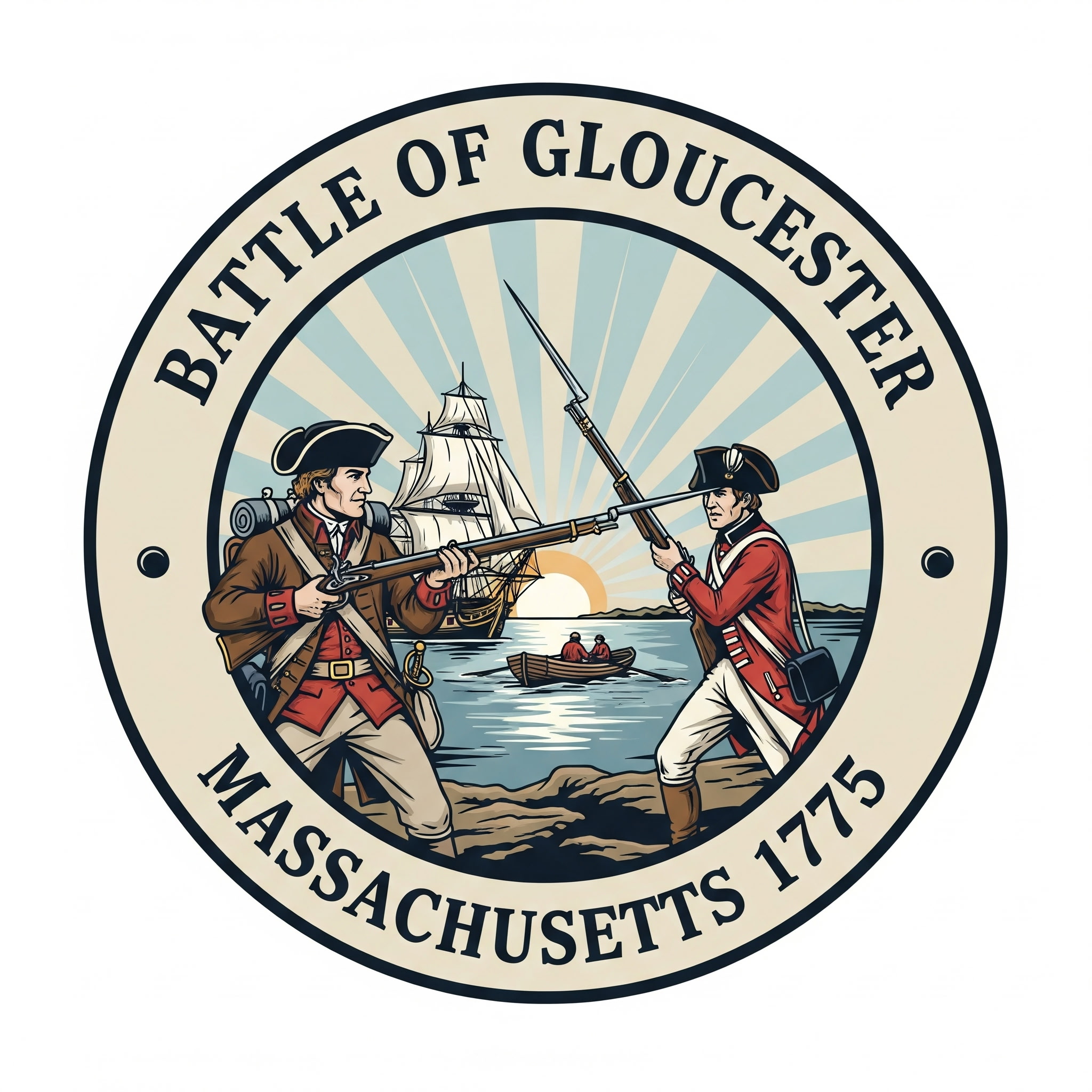
After the Battle of Bunker Hill, British officials in Boston believed that several coastal towns, such as Salem to the north, Beverly, Ipswich, Newburyport, and Gloucester, served as supply hubs for the American forces surrounding Boston. As a result, these towns became key targets for British naval attacks and landings. To interrupt American supply routes, Vice Admiral Samuel Graves of the Royal Navy commanded Captain John Linzee of the fourteen-gun sloop HMS Falcon to “to put to Sea as soon as possible in his Majesty’s Sloop under your Command and cruise between Cape Cod and Cape Ann in order to carry into Execution the late Acts for restraining the Trade of the Colonies And to seize and send to Boston all Vessels with Arms Ammunition, Provisions, Flour, Grain, Salt, Melasses, Wood, &c &c.”2
Essex County was understandably on edge from threats from the sea and local militia, and alarm-list companies were constantly on alert. Less than two weeks after the Battles of Lexington and Concord, Salem, Marblehead, Newburyport and York (ME), petitioned the Massachusetts Provincial Congress “that the long line of sea coast was without adequate defence; that armed vessels were hovering about the ports, ready to turn their cannon upon the villages of the shore; that the people were exhausted by strenuous exertions in the common cause; and praying for reinforcement of men, and supplies of arms and ammunition.”3 the next day, the Congress resolved “That it be, and it hereby is earnestly recommended to the committees of the sea port towns in the county of Essex, that they use their utmost endeavors to have all the effects of the inhabitants of their respective towns removed as soon as possible, that the Congress highly approves of the conduct of said towns in wearing a pacific ap- pearance until their effects shall be secured, that the Congress consider it as absolutely necessary for said inhabitants to be in readiness to go into the country on the shortest notice, and to avoid mixing with our enemies.”4
Of course, Essex County’s fears were not unfounded. In May, the New England Chronicle reported, “The Town of Salem, and other Parts of the County of Essex, were alarmed last Tuesday Morning by the Appearance, off Salem Harbour, of 2 or 3 armed Vessels, supposed to be on some hostile Design. A large Body of Men immediately assembled, But nothing extraordinary being attempted by the Enemy, the People dispersed, after taking some necessary Measures for their future Safety.”5 Marblehead resident Ashley Bowen noted in his journal how the Royal Navy was constantly harassing the seaport town, including an occasion when the HMS Merlin “blocked our harbor up.”6 In Newburyport, residents were rattled upon learning that a detachment of British sailors and officers from the HMS Scarborough rowed into Newburyport Harbor under the cover of darkness to scout the town’s defensive capabilities. According to the Essex Journal, “last Tuesday evening (May 23), a barge belonging to the man of war lying at Portsmouth, rowing up and down the river to make discoveries with two small officers and six seamen.”7 In early August, the commanding officer of the HMS Scarborough, then anchored off the coast of Portsmouth, New Hampshire, recommended that Newburyport be bombarded. Admiral Graves admitted such an operation was unlikely only due to the lack of ships. “I observe what you say about Newbury; that place and all others indeed require to be strictly attended to, but where are the Ships?”8
The Royal Navy’s aggressive actions only inflamed the country’s growing fear of potential and actual raids. The Reverend Daniel Fuller of Gloucester noted that a false rumor of British troops landing in Beverly sparked panic throughout the region. “Rode to Middleton in Company with Israel Eveleth, met an Alarm upon Cheboffet Causeway, it was said a Body of Regular Troops were landed & landing at West Beach Beverle.”9 The minister also noted that many communities, including his own, were heeding the advice of the Provincial Congress and moving valuables, food supplies, and livestock inland so as to avoid capture. “People in this Parish chiefly employed in removing Household Furniture and Provision of all kinds from ye Harbours to this Place.”10 By mid July, Massachusetts officials finally relented and agreed to allow companies of soldiers from coastal communities serving at the Siege of Boston to return home to construct fortifications and protect their towns.11
The Falcon was no stranger to these raids and had already captured the attention of the Massachusetts colonists by participating in the bombardment of American forces during the Battle of Bunker Hill. It had now turned its focus to coastal Essex County. Throughout the months of June and July, the Falcon cruised the New England coastline, often anchoring off of Portsmouth and dispatching sailors and marines to seize unattended coastal guns and forage for supplies.12 On August 5, 1775, HMS Falcon entered Ipswich Bay and anchored at the mouth of the Annisquam River. Captain Linzee promptly dispatched a landing party to seize sheep from a nearby pasture to provide the ship with mutton. Major Peter Coffin, a local farmer, suspected British intentions and quickly alerted the laborers on his land and neighboring residents. Armed with muskets, the small group took up concealed positions behind the dunes and opened fire as the ship’s boat approached. Believing a full company of militia lay in wait, the British officer leading the landing party abandoned the mission and returned to the Falcon empty-handed.
On the eve of the Battle of Gloucester, the HMS Falcon patrolled the waters off Cape Ann, seeking to capture colonial merchant ships bound for Salem or Newburyport. On August 8th, Captain Linzee spotted two schooners, likely from the West Indies, en route to Salem. He seized one as a prize and chased the other into Gloucester Harbor, where the fleeing vessel ran aground near Five Pound Island. The unusual sight quickly drew the attention of Gloucester residents, who soon saw the British warship towing a captured schooner. Recognizing the danger, the town meeting house began ringing its alarm bells, summoning the militia to assemble. Despite lacking cannons and having a very limited supply of powder and ammunition, the residents managed to mount a pair of swivel guns on makeshift carriages and position them for defense.
It is unclear whether Gloucester’s civilians fled the approaching fight or remained as spectators. In a letter to John Murray, Gloucester resident Judith Sargent noted that a week before the engagement, the Royal Navy schooner HMS Hope anchored in the harbor. A panic quickly set in, and the town’s militia and alarm lists assembled. According to Sargent, “You wish for some particulars relative to our publick affairs, and indeed they have somewhat varied since you left us — Upon the day of your departure, the arrival of a schooner belonging to his Britannick Majesty, threw our people into great alarm — Immediately the drums beat to arms, the [bells] sounded portentously, and the streets were filled with the goods of the terrified inhabitants — [Families] running up and down, throwing abroad their hands, the most heart affecting distress visible in their almost frantic gestures, when to heighten the misery of the scene.”13 Unlike other accounts of civilian evacuation during the Battles of Lexington and Concord, Sargent’s account notably does not mention whether civilians fled to the Essex interior when the Hope anchored off of Gloucester’s coast. Similarly, there are no civilian accounts documenting a flight on the day the Falcon attacked.
Undeterred by the alarm bells, Linzee ordered his ship into Gloucester’s harbor. He quickly seized a nearby dory belonging to fisherman William Babson and ordered him to pilot the Falcon into the harbor. The captain warned that if Babson did anything “to let the ship strike bottom, I will shoot you on the spot.”14 The sloop anchored between Stage Head and Ten Pound Island, dispatching three whaleboats carrying thirty-six sailors and marines toward the grounded schooner.
As the naval boats closed in on the grounded vessel and began to board, musket fire from the shore killed three sailors and wounded a lieutenant in the thigh. The barges withdrew with their casualties, leaving much of the boarding party behind on the schooner. In response, Linzee sent the previously captured schooner, now manned by a British prize crew, along with several small boats, all ordered to fire on any “damned rebel” within range. He also ordered a cannonading of the town by the Falcon in an attempt to draw attention away from the schooner, but “the Rebels paid very little Attention to the firing from the Ship.”15
While the boarding party was still pinned down on the schooner, Linzee sent a landing party to set fire to the town. “I made an Attempt to set fire to the Town of Cape Anne and had I succeeded I flatter myself would have given the Lieutt an Opportunity of bringing a Schooner off, or have left her by the Boats, as the Rebels Attention must have been to the fire. But an American, part of my Complement, who has always been very active in our cause, set fire to the Powder before it was properly placed; Our attempt to fire the Town therefore not only failed, but one of the men was blown up and the American deserted.”16 Enraged, Linzee dispatched yet another landing party with orders to burn the town by torching the fish flakes. However, Gloucester militiamen quickly swarmed the landing party and took them prisoner. As Linzee would bitterly report, “A second Attempt was made to set fire to the Town, but did not succeed.”17
Gloucester’s survival from being torched was due to both the bravery of its residents and a series of fortunate events. If the British forces had succeeded in setting fires, the town’s wooden houses and fish sheds could have been destroyed within hours.
At four o’clock in the afternoon, Linzee made one final push to seize the schooner and rescue his captured sailors. As several boats closed on their targets, the Falcon continued to pour broadsides into the fishing village. Surprisingly, the militiamen did not yield. As Gloucester’s Reverend Daniel Fuller recalled, “Lindsey, Capt of a man of war, fired it is supposed near 300 Shot at the Harbor Parish. Damaged ye meeting House Somewhat, Some other buildings, not a Single Person killed or wounded with his Cannon Shot.”18
A wounded officer and a few men were rescued from the grounded schooner. The rest of the crew, including several impressed Americans, were eventually captured or rescued by Gloucester militiamen. By 7 p.m., all the British small boats had been seized. In a last attempt to recover his men, Linzee sent the prize schooner into the harbor. However, he later believed that the original crew had taken the chance to overpower the British prize crew and retake the vessel. As Linzee explained, “After the master was landed, I found I could not do him any good, or distress the rebels by firing, therefore I left off.”19 Linzee and the Falcon remained off of Cape Ann until the next morning and then sailed back to Boston.
The ship-to-shore engagement resulted in a decisive American victory. Gloucester’s men recaptured both schooners and took thirty-five British sailors, several wounded, with one dying shortly afterward. Twenty-four of the captured men were sent initially to the “Ipswich Gaol” and then ultimately transferred to an American prison camp in Cambridge.20 At the same time, local sailors who had been previously impressed into the British Navy were released and allowed to return home.
Captain Linzee’s failed raid on Gloucester significantly influenced later British naval reprisals. In October 1775, Admiral Graves ordered Captain Henry Mowat of HMS Canceaux to punish several New England coastal towns, citing Linzee’s defeat as a reason.21 Although Gloucester was among the targets, Mowat chose not to attack it, concluding that the town’s spread-out buildings made bombardment ineffective. Instead, his decision to burn Falmouth, now Portland, Maine, was crucial in motivating the Continental Congress to create the Continental Navy.
The Battle of Gloucester, though often overshadowed by larger conflicts, had significant and lasting effects. It revealed vulnerabilities in British naval operations along the coast, strengthened local resolve, and laid the groundwork for a naval force that would eventually challenge British maritime dominance.
Historical information provided by Alex Cain.
- “The Battle of Gloucester” was composed by Alexander Cain, February 22, 2026. This material is the property of the author and may not be republished without express permission.
- William Bell Clark,ed., Naval Documents of the American Revolution volume 1 (Washington, DC: Government Printing Office, 1964), 900 (NDAR).
- Massachusetts Provincial Congress, The Journals of Each Provincial Congress of Massachusetts in 1774 and 1775, and of the Committee of Safety, with an Appendix, Containing the Proceedings of the County Conventions-Narratives of the Events of the Nineteenth of April, 1775-Papers Relating to Ticonderoga and Crown Point, and Other Documents, Illustrative of the Early History of the American Revolution (Boston: Dutton and Wentworth, Printers to the State, 1838), 152 n. 2, https://archive.org/details/journalsofeachprma00mass/page/152/mode/2up.
- Journals of the Massachusetts Provincial Congress, 160.
- United States, Naval Documents of the American Revolution, vol. 1, ed. Naval History Division, Department of the Navy (Washington, DC: Naval History Division, 1964), New England Chronicle, 25 May–1 June 1775, in vol. 1, 585.
- Ashley Bowen, “Chapter XIV (1775),” in The Journals of Ashley Bowen (1728–1813) of Marblehead, vol. 45, Colonial Society of Massachusetts, accessed February 22, 2026, https://www.colonialsociety.org/node/737.
- “Essex Journal, Friday, May 26, 1775,” Naval Documents of the American Revolution, vol. 1 (American Theatre from May 21, 1775, to September 2, 1775), 537, accessed February 22, 2026, https://www.navydocs.org/node/1022.
- Vice Admiral Samuel Graves to Captain Andrew Barkley, R.N., 17 August 1775, Naval Documents of the American Revolution, vol. 1, American Theatre, May 21–September 2 1775, 1164, accessed February 22, 2026, https://www.navydocs.org/node/2147.
- Daniel Fuller, The Diary of the Revd. Daniel Fuller, with His Account of His Family & Other Matters (New York: Printed for Private Distribution at the De Vinne Press, 1894), 34, accessed February 22, 2026, https://archive.org/details/diaryofrevddanie00full/page/34/mode/2up.
- Fuller, Diary of the Revd. Daniel Fuller, 31.
- “Whereas, many able-bodied men, who were inhabitants of the seaport towns of the colony, have removed their families into the country, and have themselves left said towns, and carried with them their arms and ammunition ; therefore. Resolved, that this Congress do approve of the conduct of such persons, so far as it respects the removing the women, and children, and valuable effects. It is recommended to the male inhabitants, fit to bear arms, that they return to their respective towns, and there continue with tliat dignity and firmness which ought ever to distinguish an American, and to defend them from the ravages of the enemy, until it shall be judged by the inhabitants of such towns, at a meeting for that purpose, expedient to vacate the same.” Journals of the Massachusetts Provincial Congress, 160.
- “The Falcon’s Logs, and Other Papers,” Kinsmen and Kinswomen (blog), August 26, 2016, accessed February 22, 2026, https://kinsmenandkinswomen.com/2016/08/26/the-falcons-logs-and-other-papers/
- Judith Sargent Stevens to John Murray, July 28, 1775, Judith Sargent Murray Letter Books (blog), May 10, 2024, https://jsmletterbooks.blogspot.com/2024/05/28-jul-1775-judith-sargent-stevens-to.html.
- Joseph E. Garland, The Fish and the Falcon (Charleston SC: The History Press, 2006), 109.
- John Linzee to Samuel Graves, August 10, 1775; Garland, The Fish and the Falcon, 109.
- Ibid.
- Ibid.
- Diary of Reverend Daniel Fuller, Pastor of the Second Parish Church, in James B. Conolly, The Port of Gloucester (New York, NY: Doubleday, Doran & Company, 1940), 59.
- Garland, The Fish and the Falcon, 116.
- LSL, “The Falcon’s Logs.”
- “If possible first go to Cape Anne where Rebels thought it proper to fire upon the Falcon and where they took her Officers and Crew, and sent Prisoners in the Country.” LSL, “The Falcon’s Logs.”.